
Wednesday, April 21, 2010
Painted Tyranid Warriors


Friday, April 16, 2010
Warhammer 40,000 Battle Report: Infestation of Planet 18-D93

I played a four-player game recently, with 2500 points of Tyranids on one side, facing off against 2500 points of combined Space Marines (of the Black Templars chapter) and Space Wolves. I controlled half of the Tyranid army. We used the Battle Missions book to determine an army-specific scenario to play. The result was the Infestation mission.
Representing the late stages of a Tyranid invasion, the deployment had the defending Space Marines deploying in one corner, and the Tyranids deploying anywhere else. The entire defending army would benefit from the Preferred Enemy special rule, representing them having gotten really good at fighting Tyranids by this point. This would really help them out. The entire Tyranid army would get +1 to any cover saves, representing their adapting to the local terrain. Also, all area terrain counted as Dangerous Terrain, because the Tyranid attempts to strip the planet had started resulting in earthquakes, lava flows, and in this case poisonous/acidic water. Random game length would be used, and the side with the most kill points would be the victor.
Monday, March 22, 2010
Painting Tyranid Hormaguants
Wednesday, March 17, 2010
Gaming Superstitions
If you're a gamer, odds are that over the years you've been gaming you've picked up all kinds of little rituals and superstitions about things. It's probably unavoidable in any endeavor that involves such a great deal of randomness and uncertainty. You try to make sense of the uncontrollable senselessness of it by perceiving patterns where there are none, and trying to apply rules to that make no sense. In games that involve a lot of random chance, people seem to like to invent ways in which they can pretend to influence, and therefore exert some control over, the randomness.
For example, many people like to roll particular dice for certain types of rolls, or particular colors of dice for different armies. Some people don't like others to touch their dice, since they might rub their bad luck off on them. Some people don't like using the same set of dice for two consecutive rolls, always grabbing some "fresh" dice for a new roll. I'm sure there are countless others. Here are some that I've found myself believing in:
For example, many people like to roll particular dice for certain types of rolls, or particular colors of dice for different armies. Some people don't like others to touch their dice, since they might rub their bad luck off on them. Some people don't like using the same set of dice for two consecutive rolls, always grabbing some "fresh" dice for a new roll. I'm sure there are countless others. Here are some that I've found myself believing in:
- Never roll one single die for anything, if it can be avoided. Out of every roll you make, there will almost always be at least one "failed" roll. So if you roll a single die, it will almost certainly fail. Because of this, if there is one weapon different in a squad, I roll all the dice together and use a different colored die to represent the single weapon, and I always wait until all attacks have been resolved so I can roll all the armor saves together, instead of one at a time.
- Conversely, once you start rolling a large number of dice in a single roll, more than 15 lets say, you dramatically increase your chances of rolling really badly. So if I have a lot of dice to roll, I'm better off rolling them in multiple smaller batches than all at once. One of the batches may turn out to be a really bad roll, but it's unlikely to have multiple batches rolled consecutively to roll really badly. For this same reason, anything that allows re-rolls is much more valuable in my mind than it should be.
- Never say "anything but a one", or something similar, before making a roll. You might as well not even bother rolling at that point, you're going to fail.
- Models that are pointing always do well. I have no idea why this should be, but it is.
- Any newly painted models are going to get killed. The more pride you have in the paint job, the more spectacularly embarrassing their battlefield performance will be.
- For some reason, for really crucial rolls, I like to use dice that were sitting with the 5 side facing up. This seems to come through for me pretty often. Something about the die being used to a high number facing up, and wanting to return to that state.
Monday, March 15, 2010
Mantic Games Plastic Skeletons
I've purchased and assembled some of the Mantic Games Plastic Skeletons to hopefully use in my Vampire Counts army. For anyone else who might be interested in these, here are my thoughts on them.
Like Mantic's other stuff, the Skeleton Regiment comes in a reusable thin plastic box that resembles a VHS tape box. Inside are two thin sheets of foam, two sprues of Skeletons (one a troop sprue and one a command sprue), 20 20mm square bases, and two sheets of stickers (not water slide transfers, but regular stickers). Each sheet of stickers has 2 banners, shield designs, and a mantic point. When you save up some ridiculous number of Mantic points, you can redeem them for some limited edition stuff or something.
Most of them have shields, and many can be given either spears or single-handed weapons like swords or axes. It might be tricky if you want to arm the whole unit with spears, for a couple of reason. Each sprue of 10 skeletons only has eight spears. On top of that, three of the bodies on each sprue of 10 have a weapon already modeled in the hand. Two of them would be easy to remove and replace, the one holding the axe would be a little more difficult. So if you want to give them all spears, you'll have a little extra work to do and will need to come up with some extra spears.
You'll also probably notice there are some fun little extras included on the sprue, such as a severed Dwarf head, a skeleton bursting from the ground, and even a little skeleton dog. Those are neat, and I plan to use the bursting skeleton and the dog as just extra members of the unit. Unfortunately, they don't come with bases so you'll have to supply two extras if you want to use them in such a way. Otherwise you could add the dog as a decorative element to the base of one of the skeletons, and use the bursting guy as a marker to represent something. The other little extras can also be used for terrain pieces or objective markers or just base decorations.
While assembling them, I noticed that they did tend to have some significant mold lines. Some of these can be very difficult to get to with a hobby knife or file because they are in cramped spaces, like between a leg and the cloth hanging down between the legs. Also, some of the mold lines can be really hard to remove without removing some of the detail of the miniatures, like on the rib bones. Plus, many parts of these models are very slim and delicate, so you have to be pretty careful not to snap off an arm or weapon while you're preparing them for assembly. As a result of all that, these take a long time to prepare. This does remove some of the advantage they seem to have been going for with having few parts so they can be assembled quickly.
However, once the parts were cleaned of mold lines and ready to go, they were pretty quick and fun to assemble. Out of a regiment of 20, 12 of the figures don't have much customization. You have three different types of lower body, and you stick one of the corresponding upper bodies on. Some of these already have weapons attached, so you're done. Others have empty hands, so you pick a weapon to put in them and you're done. Or give one a horn, bell, or standard pole. By having different combinations of upper and lower body, you can have quite a variety of differences and probably have a unit of 30 without repeating any of the upper body/lower body combinations. But you don't have any way to pose them differently, aside from maybe angling them differently on the base. They are quick to assemble.
The remaining eight out of the 20 are more fun to put together. These have bodies in more dramatic poses with empty hands, or some with separate right arms that you can attach in different positions, and separate heads. This works out well, since you can get a lot of standard-looking guys put together quickly, but still have a few unique poses that are more fun to assemble and will stand out in the unit. There are extra weapon arms and heads, so you have some choices in which ones you'll want to use.
If you're like me, you may have initially been scared off from wanting these by the first pictures they had up on the Mantic website, where it looked like the whole unit was dancing. Once I saw the sprue pictures I was relieved to see that you aren't required to assemble them that way. So rest assured that you don't have to make all your skeletons look like they're dancing. There's really only one or two of them that have to look like they're dancing. I don't know what Mantic assembled theirs that way, or choose to use that terrible picture to show off their product.
Anyway, moving on, another weird thing I didn't notice at first is that these models have eyeballs modeled on them. That seems a little strange to me. But I suppose if you just paint them as glowing orbs of magical energy or something, they'll look okay.
So you might wonder, as I did, if these would work well in games of Warhammer as cheaper substitutes for the Games Workshop skeletons, or for people who prefer the style of these skeletons. In some way they seemed clearly designed for this purpose. They come with the same size bases, they have the same weapon options and the continually expanding Mantic range of undead contains a lot of unit types that are similar to the kinds of units in Warhammer undead armies.
On the other hand, these models are significantly smaller than Games Workshop miniatures. They are a little shorter for one, and in addition are much more realistically proportioned, so they don't have extra large hands, heads, and weapons. This combines to make them look much smaller than most Games Workshop miniatures. The pictures below show, from left to right: very old Games Workshop plastic skeleton, Mantic skeleton, old metal Games Workshop skeleton, another Mantic skeleton, and the previous version of the Games Workshop plastic skeleton.


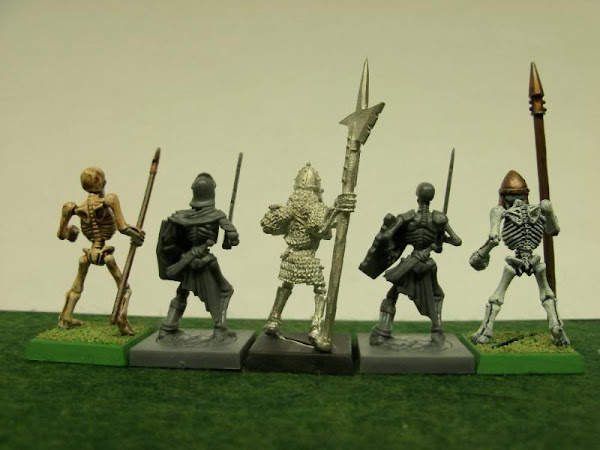

Unfortunately, I do not have any of the newest Games Workshop plastic skeletons to include in the comparison pictures. I don't really like the style of them, so I haven't bought any. I have seen them in person, and they are much smaller and way more reasonably proportioned than the previous version, so I think they would likely fit in okay with the Mantic skeletons. The older Games Workshop plastic skeletons, as you can see, don't match well at all. You definitely can't mix parts between them for conversions as they'd be way out of scale, and mixing the models in the same unit would look bad due to the different styles and proportions. It might look okay to have them in different units in the same army. You could always argue that the Games Workshop skeletons are undead mutant ape-men or something.
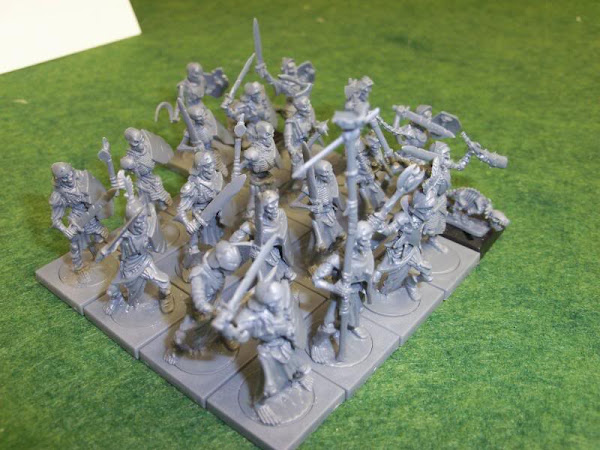
Here are some pictures of my first completed regiment of Mantic skeletons. There are 22 of them, including the skeleton dog that I based separately, and the one bursting out of the ground.



Finally, here are a couple pictures of the re-usable storage box they come in with the foam inserts. This might work okay for storing plastic models, even once painted, as they won't be heavy enough to chip each other if they move around in there. I wouldn't store any painted metal models this way.


I do have a bit of a dilemma in putting together the rest of my Mantic skeletons. There are enough of the standard swords to give all of them such a weapon, except for those that have a molded on hammer or axe. I could arm almost all of my skeletons with the swords and make them look more uniform, but I really like the variety added by some of the other weapons. So, do I make one unit all with swords, and other unit all with completely mixed weapons? In this case, one would have been an organized military unit in life, the other more of a band of warriors that used whatever weapons they could supply themselves. Or do I have most of them with swords, and a few with other weapons to represent those raised during the course of a battle, which would therefore be armed differently because they were originally part of the unit when it was alive? Or do I just mix them any way I want, figuring a vampire general would just reorganize units however was convenient? Or am I just putting way too much thought into this? Let me know what you think.
Like Mantic's other stuff, the Skeleton Regiment comes in a reusable thin plastic box that resembles a VHS tape box. Inside are two thin sheets of foam, two sprues of Skeletons (one a troop sprue and one a command sprue), 20 20mm square bases, and two sheets of stickers (not water slide transfers, but regular stickers). Each sheet of stickers has 2 banners, shield designs, and a mantic point. When you save up some ridiculous number of Mantic points, you can redeem them for some limited edition stuff or something.
Most of them have shields, and many can be given either spears or single-handed weapons like swords or axes. It might be tricky if you want to arm the whole unit with spears, for a couple of reason. Each sprue of 10 skeletons only has eight spears. On top of that, three of the bodies on each sprue of 10 have a weapon already modeled in the hand. Two of them would be easy to remove and replace, the one holding the axe would be a little more difficult. So if you want to give them all spears, you'll have a little extra work to do and will need to come up with some extra spears.
You'll also probably notice there are some fun little extras included on the sprue, such as a severed Dwarf head, a skeleton bursting from the ground, and even a little skeleton dog. Those are neat, and I plan to use the bursting skeleton and the dog as just extra members of the unit. Unfortunately, they don't come with bases so you'll have to supply two extras if you want to use them in such a way. Otherwise you could add the dog as a decorative element to the base of one of the skeletons, and use the bursting guy as a marker to represent something. The other little extras can also be used for terrain pieces or objective markers or just base decorations.
While assembling them, I noticed that they did tend to have some significant mold lines. Some of these can be very difficult to get to with a hobby knife or file because they are in cramped spaces, like between a leg and the cloth hanging down between the legs. Also, some of the mold lines can be really hard to remove without removing some of the detail of the miniatures, like on the rib bones. Plus, many parts of these models are very slim and delicate, so you have to be pretty careful not to snap off an arm or weapon while you're preparing them for assembly. As a result of all that, these take a long time to prepare. This does remove some of the advantage they seem to have been going for with having few parts so they can be assembled quickly.
However, once the parts were cleaned of mold lines and ready to go, they were pretty quick and fun to assemble. Out of a regiment of 20, 12 of the figures don't have much customization. You have three different types of lower body, and you stick one of the corresponding upper bodies on. Some of these already have weapons attached, so you're done. Others have empty hands, so you pick a weapon to put in them and you're done. Or give one a horn, bell, or standard pole. By having different combinations of upper and lower body, you can have quite a variety of differences and probably have a unit of 30 without repeating any of the upper body/lower body combinations. But you don't have any way to pose them differently, aside from maybe angling them differently on the base. They are quick to assemble.
The remaining eight out of the 20 are more fun to put together. These have bodies in more dramatic poses with empty hands, or some with separate right arms that you can attach in different positions, and separate heads. This works out well, since you can get a lot of standard-looking guys put together quickly, but still have a few unique poses that are more fun to assemble and will stand out in the unit. There are extra weapon arms and heads, so you have some choices in which ones you'll want to use.
If you're like me, you may have initially been scared off from wanting these by the first pictures they had up on the Mantic website, where it looked like the whole unit was dancing. Once I saw the sprue pictures I was relieved to see that you aren't required to assemble them that way. So rest assured that you don't have to make all your skeletons look like they're dancing. There's really only one or two of them that have to look like they're dancing. I don't know what Mantic assembled theirs that way, or choose to use that terrible picture to show off their product.
Anyway, moving on, another weird thing I didn't notice at first is that these models have eyeballs modeled on them. That seems a little strange to me. But I suppose if you just paint them as glowing orbs of magical energy or something, they'll look okay.
So you might wonder, as I did, if these would work well in games of Warhammer as cheaper substitutes for the Games Workshop skeletons, or for people who prefer the style of these skeletons. In some way they seemed clearly designed for this purpose. They come with the same size bases, they have the same weapon options and the continually expanding Mantic range of undead contains a lot of unit types that are similar to the kinds of units in Warhammer undead armies.
On the other hand, these models are significantly smaller than Games Workshop miniatures. They are a little shorter for one, and in addition are much more realistically proportioned, so they don't have extra large hands, heads, and weapons. This combines to make them look much smaller than most Games Workshop miniatures. The pictures below show, from left to right: very old Games Workshop plastic skeleton, Mantic skeleton, old metal Games Workshop skeleton, another Mantic skeleton, and the previous version of the Games Workshop plastic skeleton.
Unfortunately, I do not have any of the newest Games Workshop plastic skeletons to include in the comparison pictures. I don't really like the style of them, so I haven't bought any. I have seen them in person, and they are much smaller and way more reasonably proportioned than the previous version, so I think they would likely fit in okay with the Mantic skeletons. The older Games Workshop plastic skeletons, as you can see, don't match well at all. You definitely can't mix parts between them for conversions as they'd be way out of scale, and mixing the models in the same unit would look bad due to the different styles and proportions. It might look okay to have them in different units in the same army. You could always argue that the Games Workshop skeletons are undead mutant ape-men or something.
Here are some pictures of my first completed regiment of Mantic skeletons. There are 22 of them, including the skeleton dog that I based separately, and the one bursting out of the ground.
Finally, here are a couple pictures of the re-usable storage box they come in with the foam inserts. This might work okay for storing plastic models, even once painted, as they won't be heavy enough to chip each other if they move around in there. I wouldn't store any painted metal models this way.
I do have a bit of a dilemma in putting together the rest of my Mantic skeletons. There are enough of the standard swords to give all of them such a weapon, except for those that have a molded on hammer or axe. I could arm almost all of my skeletons with the swords and make them look more uniform, but I really like the variety added by some of the other weapons. So, do I make one unit all with swords, and other unit all with completely mixed weapons? In this case, one would have been an organized military unit in life, the other more of a band of warriors that used whatever weapons they could supply themselves. Or do I have most of them with swords, and a few with other weapons to represent those raised during the course of a battle, which would therefore be armed differently because they were originally part of the unit when it was alive? Or do I just mix them any way I want, figuring a vampire general would just reorganize units however was convenient? Or am I just putting way too much thought into this? Let me know what you think.
Wednesday, March 10, 2010
Warhammer 40,000 Battle Report: Blitzkrieg on Planet 18-D93
I recently played another game of Warhammer 40,000 up at the Battle Bunker in Downers Grove, Illinois. We agreed to 1500 points of my Tyranids against my opponent's Orks. The Battle Missions book had just been released, so I picked up a copy when I arrived at the store. It contains 30 new missions that don't require any special table setup or force organization chart or army selection, so we decided we would play one of those.
Each army had three missions in the book that are particularly suited to their style of warfare. If you wish to play one of these (as opposed to randomly playing any of the 30 missions in the book), you roll off with your opponent. The winner will play one of the three missions specific to their army. That player rolls a D3 to determine which of the 3 missions to play. You could accomplish the same thing by one player rolling a single D3 for which of the three missions, with an odd number meaning choose from one army's missions, and even meaning the other. Then again, if you didn't like a lot of die rolling, you wouldn't be playing this game anyway.
Monday, March 8, 2010
Tyranid Hormagaunts and Weights
Subscribe to:
Posts (Atom)